The NDIS explained: eligibility, access, and how plans work
Our Mate editorial team.Last reviewed August 2026.

The National Disability Insurance Scheme, the NDIS, is the way Australia funds support for people with permanent and significant disability. It is large, life-changing for those it covers, and genuinely hard to understand from the outside. The acronyms pile up fast, and the path from "I think I might be eligible" to "I have a plan I can use" is not obvious.
This guide explains the scheme in plain language: who it is for, how to get access, what a plan actually contains, who manages the money, and how the NDIS differs from the aged care system. It is written for people with disability and for the family members, carers, and supporters who help them navigate it.
The short version: the NDIS funds reasonable and necessary supports related to a person's disability, through an individual plan with a budget split across categories. It is administered by the National Disability Insurance Agency (NDIA). It is not means tested, and it is separate from the aged care system.
What the NDIS is, and is not
The NDIS funds support that a person needs because of a permanent and significant disability. "Reasonable and necessary" is the test that runs through everything: a support has to be related to the disability, help the person pursue their goals, and represent value for money, and it must not be something another system is responsible for (health, education, or aged care).
It is an insurance scheme, not a welfare payment. There is no income or assets test. A person on a high income and a person on the pension are assessed the same way, on the basis of disability and need. It does not replace Medicare, the public hospital system, or the school system; those keep their own responsibilities, and the NDIS funds the disability-specific supports around them.
Who is eligible
To access the NDIS, a person generally needs to meet all of the following:
- Age: be under 65 when they first apply. (People who join before 65 can continue past that age; people who first need support at 65 or over are directed to the aged care system instead.)
- Residence: live in Australia and be an Australian citizen, permanent resident, or hold an eligible visa.
- Disability: have a permanent and significant disability that substantially affects their ability to take part in everyday activities; or, for young children, meet the early intervention requirements where support now will reduce future need.
The disability requirement is the substance of it. The impairment must be permanent (likely to be lifelong) and significant (it substantially reduces functional capacity in areas such as communication, mobility, self-care, self-management, learning, or social interaction).
For young children, there is an early childhood approach: families can often get help and early intervention without the child first having a formal diagnosis, on the basis of developmental concerns.
How to apply for access
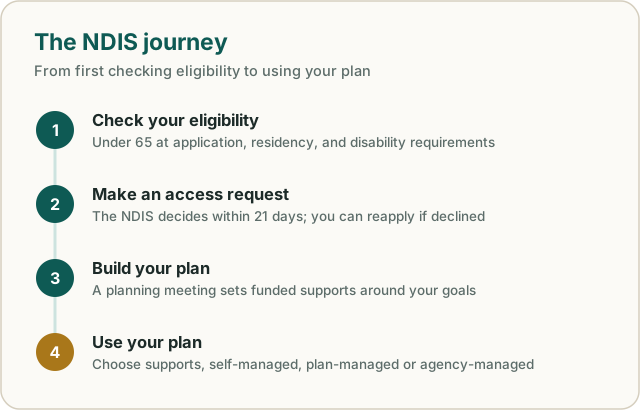
The application is called an Access Request. The steps are broadly:
- Confirm the basics: check age, residence, and that the disability is likely to meet the test. The NDIS website has eligibility checklists.
- Make an Access Request: by calling the NDIS on 1800 800 110, or with help from a local area coordinator or early childhood partner. You can ask for the request to be started over the phone.
- Provide evidence: this is the part that makes or breaks an application. You will need evidence from treating professionals (GP, specialist, allied health) that sets out the disability, that it is permanent, and how it affects daily function. Strong, specific, functional evidence is far more persuasive than a bare diagnosis.
- Receive a decision: the NDIA decides whether the person meets the access criteria. If access is granted, the planning process begins. If it is refused, there is a review pathway.
If an Access Request is refused, do not treat it as the end. Many initially-refused applications succeed on review or on a fresh request with stronger evidence. A letter from an allied health professional describing functional impact in concrete terms is often the missing piece.
What an NDIS plan contains
Once access is granted, the person works through a planning conversation that produces their plan. The plan sets goals and allocates a budget across funding categories. There are three you will hear about constantly:
| Budget | What it funds | Examples |
|---|---|---|
| Core supports | Everyday assistance and disability-related daily living | Personal care, help in the community, consumables, some transport |
| Capacity building | Building skills and independence over time | Therapy, support coordination, employment and daily-living skills |
| Capital supports | One-off, higher-cost items | Assistive technology, equipment, home modifications |
The important practical differences:
- Core is usually the most flexible. Funding can often be moved between core support types as needs shift.
- Capacity building is more fixed. Funding sits in specific sub-categories and generally cannot be moved between them; it is meant to build capability, not to be open-ended.
- Capital is tied to the specific item it was approved for. Money quoted and approved for a wheelchair funds that wheelchair.
A support coordinator, if funded, sits within capacity building and helps a participant turn the plan into actual services. Whether you need one is worth thinking through, and our dedicated guide covers it.
Plan management: who handles the money
Every plan has to be managed somehow. There are three options, and a plan can combine them:
- Agency-managed (NDIA-managed): the NDIA pays providers directly. The simplest to run, but you can only use NDIS-registered providers, which narrows choice.
- Plan-managed: a plan manager (a provider funded separately in your plan) pays the invoices and tracks the budget for you. You get the administrative help and can use both registered and unregistered providers. For many people this is the practical middle ground.
- Self-managed: you receive and manage the funds yourself, claim from the NDIS, and pay providers. The most flexibility and choice, but the most administration and record-keeping.
You can ask for the management option you want at planning. Plan management does not come out of your support budgets in a way that reduces them; the funding for a plan manager is separate.
How the NDIS differs from aged care
This trips up a lot of families, particularly where age and disability overlap. The simplest framing:
- The NDIS is for people with disability who enter the scheme before 65. It is not means tested and funds disability-specific supports.
- The aged care system is for older people whose needs are age-related, accessed through My Aged Care and an aged care assessment. It can involve fees based on income and assets.
A person who is on the NDIS before turning 65 generally stays on it; they are not pushed into aged care just because they have a birthday. A person who first develops support needs at 65 or older is directed to aged care, not the NDIS. Where someone has both a longstanding disability and emerging age-related needs, the situation can be more nuanced, and it is worth getting advice on which system funds what.
If something goes wrong
Two things are worth knowing. First, decisions can be reviewed: if you disagree with an access decision, a plan, or a funding amount, there is a formal review process, and beyond that the Administrative Review Tribunal. Second, quality and safety are overseen by the NDIS Commission, which handles complaints about providers. If a provider is not delivering or behaves improperly, that is where a complaint goes.
To find registered NDIS providers and support coordinators, browse our NDIS directory.
Recent and upcoming changes
The NDIS is going through its biggest set of changes since it began, so it is worth knowing what is moving.
In May 2026 the federal government introduced the National Disability Insurance Scheme Amendment (Securing the NDIS for Future Generations) Bill to Parliament. It proposes changes across several areas, including eligibility, how plans are built, claiming timeframes, and provider regulation. As at this guide's last review it was still before Parliament, so it is proposed legislation rather than settled law.
Separately, governments are building "foundational supports": disability support delivered through mainstream and community services for people who need help but are not NDIS participants. The first stage, Thriving Kids, begins rolling out from October 2026 for younger children with developmental delay or autism and lower support needs, with those supports delivered outside individual NDIS plans.
Because these reforms are still being legislated and rolled out in stages, treat any specific date here as indicative and check ndis.gov.au for the current position before making decisions.
Frequently asked questions
Is the NDIS means tested?
No. The NDIS is an insurance scheme, not a welfare payment, so there is no income or assets test. Eligibility turns on age, residence, and having a permanent and significant disability. Your income makes no difference to whether you can access the scheme or what you are funded.
What is the difference between the NDIS and aged care?
The NDIS funds disability-related supports for people who enter before 65 and is not means tested. The aged care system supports older people with age-related needs, is accessed through My Aged Care, and can charge fees based on income and assets. People already on the NDIS generally stay on it past 65 rather than moving to aged care.
What does "reasonable and necessary" mean?
It is the test the NDIA applies to every support. To be funded, a support must relate to the person's disability, help them pursue their goals and take part in life, represent value for money, be effective, and not be the responsibility of another system such as health or education. It is the filter that decides what a plan will and will not pay for.
What happens if my Access Request is refused?
A refusal is not the end. You can request a review of the decision, and many applications succeed on review or on a fresh request with stronger evidence. The most effective step is usually better functional evidence from treating professionals, describing in concrete terms how the disability affects daily life, not just naming a diagnosis.
What is the difference between core, capacity building, and capital funding?
Core funds everyday disability-related assistance and is usually the most flexible. Capacity building funds skill-building and independence over time and is fixed to specific sub-categories. Capital funds one-off higher-cost items like equipment, assistive technology, and home modifications, and is tied to the specific item approved.
Do I need a support coordinator?
Not always. Some participants manage well with help from a local area coordinator and informal supports. A support coordinator is most useful for new or complex plans with several providers to organise. Whether one is funded is decided at planning, and our guide on the support coordinator role covers when it is worth having.
Related guides
What is an NDIS support coordinator and do I need one?
Plain-language guide to NDIS support coordinators: what they do, how they differ from a local area coordinator, whether you need one, and how to choose well.
What support is available for carers in Australia?
A practical guide to support for unpaid carers in Australia: Carer Gateway, financial entitlements, respite, NDIS and aged care pathways, and carer wellbeing.
What support is available for elderly people living alone in Australia?
A plain-language guide to support for older Australians living alone: home care, community connection, safety, health, and financial help.