Home care package vs CHSP: what is the difference?
Our Mate editorial team.Last reviewed June 2026.

If you have recently called My Aged Care, or been referred by a GP, you have probably heard several terms thrown around: home care package, Commonwealth Home Support Programme, and now Support at Home. They sound like they might be the same thing. They are related, but they are not interchangeable, and the system is mid-way through a significant change that this guide explains in plain language.
The headline change is this. The home care package program, the funded personal budget that older Australians used to buy in-home care, has been replaced by a new program called Support at Home, which started on 1 November 2025. The Commonwealth Home Support Programme (CHSP), the entry-level program for small amounts of organised help, is still running for now and is scheduled to fold into Support at Home later, no earlier than 1 July 2027. So at the time of writing there are two live pathways: Support at Home (the replacement for home care packages) and CHSP (still operating in its existing form). Both are accessed through My Aged Care on 1800 200 422.
People still search for "home care package vs CHSP", and clinicians and families still use the old language, so this guide keeps the familiar terms while explaining what each one has become. For the current detail on any of this, My Aged Care is the authoritative source, because the transition is being rolled out in stages.
What is changing, in short
- Home care packages are gone as a new program. From 1 November 2025 they were replaced by Support at Home. The Short-Term Restorative Care programme was also folded into the change.
- People already on a home care package before the change generally moved across to Support at Home under arrangements designed to keep them no worse off. If this applies to you or a relative, ask your provider or My Aged Care exactly how the transition affects the budget and fees.
- CHSP continues for now. It has not yet been replaced and keeps running in its current form until it transitions to Support at Home, no earlier than 1 July 2027.
- The assessment that gates all of this also changed in December 2024, when ACAT and RAS were folded into a single assessment system. See our guide to the aged care assessment for how that works now.
The mechanics below describe the system as it stands during this transition. Because dates and detail can move as the rollout continues, treat My Aged Care as the current position and use this guide for the shape of how things fit together.
What is the Commonwealth Home Support Programme?
CHSP is the entry-level pathway into government-funded home care in Australia. It is designed for older people who need a small amount of assistance to remain living at home safely and independently, not comprehensive care, but targeted help with specific tasks.
The program covers a defined set of service types: domestic assistance (cleaning, laundry, basic household tasks), personal care (help with showering, dressing, grooming), transport to medical appointments and community activities, delivered meals, social support and community participation programs, home maintenance and minor modification (grab rails, ramp installation, fixing hazards), and some allied health services including podiatry and physiotherapy.
The way CHSP works differs from the package model. You do not receive a budget to manage. Instead, My Aged Care refers you to local providers who deliver specific services, and you pay a small co-contribution. Co-contribution amounts vary by provider and service type within government guidelines; ask the provider what they charge, and check the current position with My Aged Care. The government subsidises the majority of the cost directly.
CHSP eligibility is based on care need rather than a financial hardship test. Access is faster than the package pathway in most cases. After your My Aged Care intake call, an assessor will contact you, sometimes by phone, sometimes in person, and if your needs are straightforward, referrals to local CHSP providers can follow within weeks rather than months.
CHSP is the part of the system that has not yet changed. It is scheduled to move into Support at Home no earlier than 1 July 2027, so until then it continues to operate as described here.
What was a home care package, and what is Support at Home?
A home care package was a funded personal budget assigned to a person, which they used to buy care services from a registered provider. From 1 November 2025 this model was replaced by Support at Home, which keeps the same basic idea, a person-centred budget for ongoing in-home care, but restructures how the funding levels work.
Under the old home care package system there were four package levels (Level 1 through Level 4), with funding increasing at each level. Support at Home replaces those four levels with a wider set of ongoing classifications spanning lower, moderate, and higher care needs. The principle is the same: an assessment determines the level of need, and a corresponding funding amount is attached. The detail, how many classifications there are and the dollar figure at each, is indexed and updated over time, so check My Aged Care for the current classifications and budgets rather than relying on any figure published here.
What Support at Home funds
The flexibility is considerable, much as it was under home care packages. Within the budget, a person can fund: personal care, nursing visits, allied health (physiotherapy, occupational therapy, podiatry, dietetics, speech pathology), domestic assistance, meal preparation, transport, social support, assistive technology, home modification, and care management. The mix is determined in consultation with the provider. Support at Home also includes specific funding pathways for things like assistive technology and home modifications; My Aged Care can explain how these work under the current rules.
A person contributes towards the cost based on their financial circumstances. How those contributions are calculated changed with the move to Support at Home, and the means assessment is conducted through Services Australia. Because the contribution rules are part of what changed in the reform, do not assume the old home care package fee structure still applies; confirm the current position with My Aged Care and see our guide to aged care fees for how the pieces fit together.
Provider-managed, plan-managed, and self-managed
As with home care packages, most people use a provider-managed arrangement: the provider handles the administration, employs or subcontracts the workers, and manages compliance. Some people prefer more control over who they use, and arrangements that sit between fully provider-managed and fully self-managed exist. The administrative options under Support at Home are an area the provider can walk you through; ask what is available before you sign a service agreement.
The key differences side by side
| CHSP | Support at Home (replaces home care packages) | |
|---|---|---|
| Status | Current; transitions to Support at Home no earlier than 1 July 2027 | Live since 1 November 2025 |
| What you receive | Specific organised services | A personal budget at an assessed classification |
| Who chooses services | Provider and assessor | You and your provider |
| Contribution | Small co-contribution per service | Contribution based on financial circumstances (assessed by Services Australia) |
| Access speed | Usually weeks | Can take longer for higher needs |
| Best suited to | Light, specific assistance needs | Regular ongoing care needs |
| Entry point | My Aged Care 1800 200 422 | My Aged Care 1800 200 422 |
The wait, and what to do in the meantime
This is the part most government information softens. The pathway into ongoing in-home support has historically involved a wait, particularly for higher levels of need, in some cases several months. The move to Support at Home was accompanied by changes intended to release more funded support and shorten waits, building on the funding increases that followed the Royal Commission into Aged Care Quality and Safety. Whether that has flowed through to your region is worth checking directly.
The My Aged Care portal shows estimated wait times. These are averages and your actual experience will depend on your region and the providers in your area. The figures are worth checking when you register, and worth checking again periodically; they change as funding and demand shift.
The most important thing to know: you do not have to wait with nothing in place. It is often possible to receive entry-level support, including CHSP services, while waiting for an ongoing Support at Home budget to start. Ask My Aged Care explicitly about interim support when you register.
If your needs increase, you can request a reassessment at any time; you do not have to wait for a scheduled review.
Which pathway is right for your situation?
A reasonable starting framework, though an assessor will confirm what applies to your circumstances:
- Light, occasional help: a few hours a week of domestic assistance, transport, or meals. CHSP is likely the right fit while it continues to operate, and is usually the faster pathway.
- Regular care needs across multiple areas: personal care several times a week, plus nursing or allied health. An ongoing Support at Home budget is likely more appropriate.
- Complex, high-level needs: significant personal care, nursing, and allied health coordination. A higher Support at Home classification. Start the process early given that higher needs can mean a longer wait.
- Disability alongside age-related needs: some supports may be funded through the NDIS rather than the aged care system. The two can run in parallel in some circumstances; My Aged Care can advise on the right pathway.
How to apply for either pathway
The entry point is the same for both: My Aged Care, either by calling 1800 200 422 or registering online at myagedcare.gov.au. The call takes around 20 minutes. An operator will ask about the person's current situation and care needs, and will refer for an assessment if appropriate.
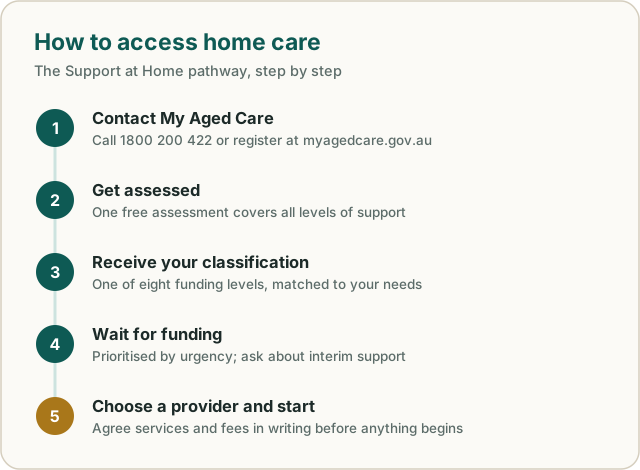
Since December 2024, a single assessment system determines what a person is eligible for. A lighter home support assessment (what people used to know as the Regional Assessment Service check) suits straightforward needs; a more detailed comprehensive assessment (what people still call an ACAT assessment) is needed for higher-level in-home support, residential aged care, and government-funded residential respite. My Aged Care decides which one a person needs after the first call. See our guide to the aged care assessment for what happens at each.
Family members and carers can call on behalf of the older person with their consent. If the person lacks capacity to give consent, an enduring power of attorney or guardian can act on their behalf.
Frequently asked questions
What happened to home care packages?
Home care packages were replaced by a new program called Support at Home on 1 November 2025. Support at Home keeps the idea of a person-centred budget for ongoing in-home care but restructures the funding levels. People who were already on a home care package generally moved across to the new program under transition arrangements. Check the current detail with My Aged Care, as the rollout is staged.
Is CHSP being replaced too?
Yes, but not yet. The Commonwealth Home Support Programme is still operating in its current form and is scheduled to fold into Support at Home no earlier than 1 July 2027. Until then you can still be referred to CHSP services through My Aged Care.
Can I receive both CHSP and a Support at Home budget at the same time?
Generally the expectation is that once you have an ongoing budget your care needs are met within it rather than supplemented by CHSP, with some limited exceptions. While you are waiting for an ongoing budget to start, you can usually receive CHSP or other entry-level support in the meantime. Ask My Aged Care what applies in your situation.
What happens to my support if I go into hospital?
An ongoing in-home arrangement can typically be paused while you are in hospital rather than lost. How this is managed depends on your provider and the length of your stay. Confirm the arrangements with your provider when you are admitted.
Can I change providers if I am unhappy?
Yes. You can change providers. There is a process involving notice periods specified in your service agreement, and you will usually want to line up a new provider before exiting the old one to avoid a gap in care. Contact My Aged Care if you are having difficulty with a provider.
What if I cannot afford the contributions?
Financial hardship provisions exist in the aged care system. Under CHSP, providers have some flexibility on co-contribution amounts. Under Support at Home, if your assessed contribution creates genuine hardship there are provisions to address it. Raise this directly with My Aged Care or your provider, and see our guide to aged care fees.
Does my parent have to agree to an assessment?
Yes. An adult with capacity has the right to decline an assessment. You cannot arrange an assessment for someone without their consent. If the person lacks capacity, the appropriate legal authority (enduring guardian or power of attorney) can provide consent.
Related guides
ACAT assessment: what to expect and how to arrange one
Plain-language guide to the aged care assessment (ACAT, called ACAS in Victoria): who needs one, how to arrange it, what happens, and the approvals it gives.
Aged care fees explained: what you actually pay
Plain-English guide to aged care costs in Australia: home care contributions, the basic daily fee, means-tested fees, and accommodation deposits (RAD and DAP).
What support is available for elderly people living alone in Australia?
A plain-language guide to support for older Australians living alone: home care, community connection, safety, health, and financial help.
How to get a parent into aged care in Australia
A step-by-step guide to the aged care entry process: from the first call to My Aged Care through choosing a facility and understanding the costs.